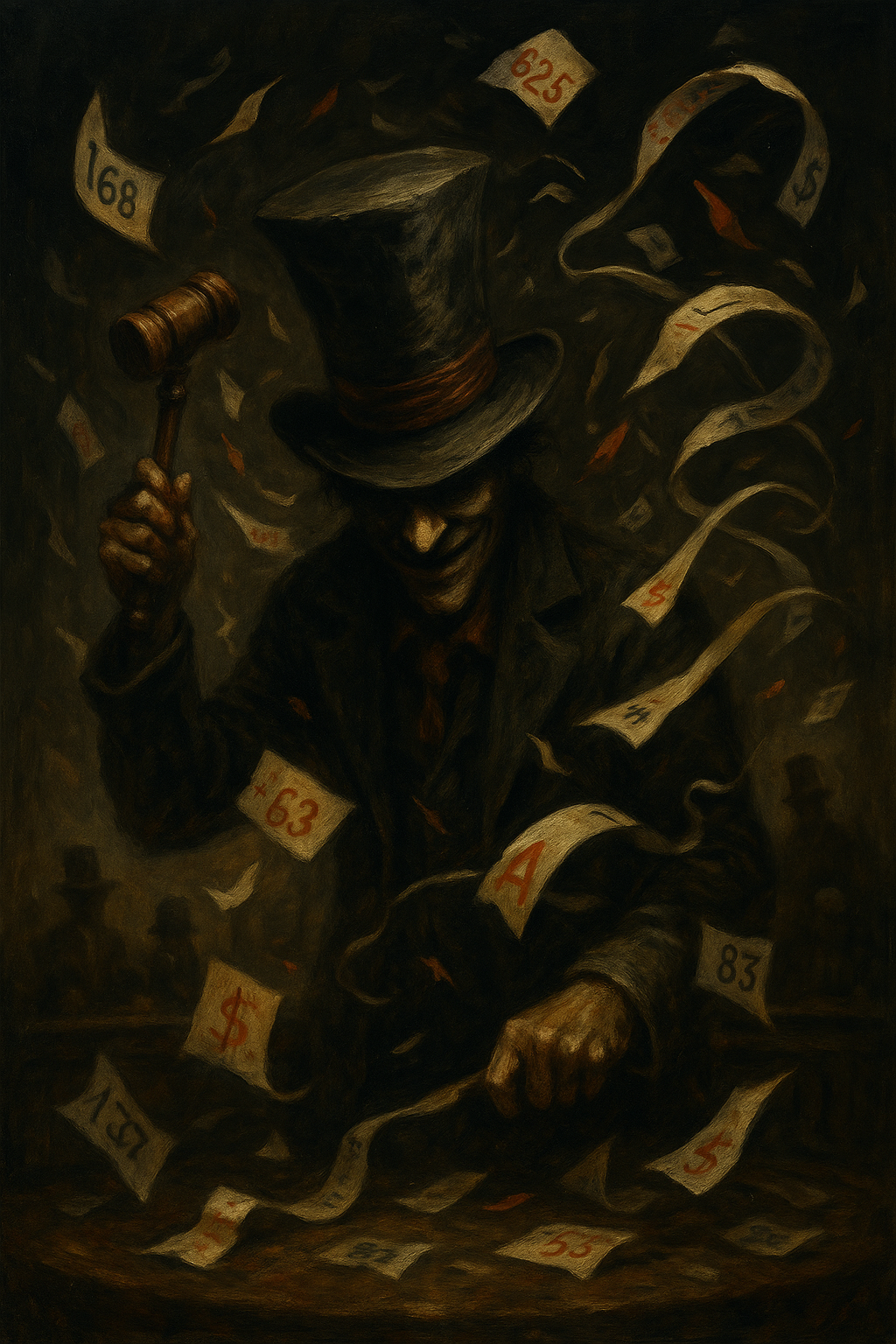
The room is poorly lit.
Not dark — just dim enough that edges soften and faces blur into suggestion rather than form. Gaslight flickers along the walls, reflected in warped mirrors that seem to bend proportion and distance. The air is thick. Not with smoke, but with something older. Anticipation, perhaps. Or habit.
They have all been here before.
At the center stands the auctioneer.
Tall. Slightly bent. Dressed in something that once resembled Victorian formality — tails, a waistcoat, gloves worn thin at the fingers. His hat sits too high, tilted just enough to suggest either carelessness or intent.
His smile is constant.
Not warm. Not cold.
Fixed.
“Ladies and gentlemen,” he begins, voice smooth, almost playful,
“we have a fine selection tonight.”
A ripple moves through the room. Not excitement — recognition.
The first item is presented.
A polished instrument. Elegant. Complex.
Wrapped in language no one fully understands, but everyone pretends to.
“Structured yield,” he says lightly.
“Enhanced return, with limited downside.”
A few nod.
Bidding begins — not with conviction, but with familiarity.
Hands raise because they always have.
Sold.
The lots come faster now.
Duration.
Credit.
Carry.
Volatility, packaged and inverted.
Each one described with just enough clarity to be believable,
and just enough ambiguity to remain unquestioned.
The crowd does not evaluate.
It participates.
There is comfort in the motion —
in the cadence of bid and hammer,
in the illusion that price implies understanding.
At some point, the items begin to change.
Subtly at first.
A small box labeled Liquidity —
sealed, but assumed to be full.
A contract marked Diversification —
identical to the last three sold.
A ledger titled Risk Premium —
pages blank, but thick with promise.
No one hesitates.
The room has already agreed to the rules.
He watches them closely.
Not with contempt —
but with interest.
He does not force the bids.
He does not deceive.
He simply offers.
Again and again.
Always something new,
always something familiar.
His voice never rises.
His smile never fades.
At one point, a different item is brought forward.
It does not belong.
No label.
No structure.
No yield attached.
Just a small, indistinct thing —
light, almost weightless.
The room shifts.
“What is it?” someone asks.
The auctioneer pauses.
For the first time, the smile falters.
He removes his glove, slowly, as if to confirm what he is holding is real.
“Not for sale,” he says quietly.
A murmur spreads.
“Everything is for sale,” another voice insists.
The auctioneer replaces the glove.
“No,” he replies.
A beat.
“This is the only thing that isn’t.”
He sets it aside, out of reach, out of view.
And for a moment — just a moment —
the room feels different.
Clearer.
Then the next lot is announced.
The auction never ends.
It does not close.
It does not reset.
It continues — through cycles, through regimes, through names and instruments and eras.
Only the items change.
The participants remain.
Most leave with something in hand.
Few remember why they raised it.
Fewer still ask who set the terms.
Somewhere, just beyond the light,
the auctioneer adjusts his hat
and prepares the next lot.
The smile returns.
The room settles.
And the bidding begins again.